
.svg)
.png)


August 7, 2026
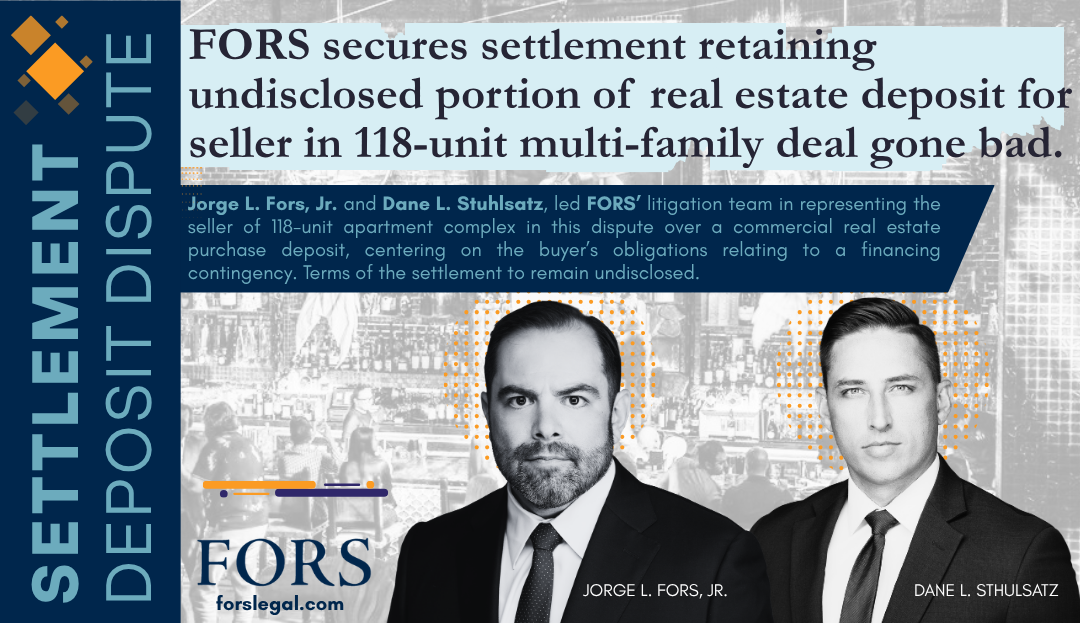
FORS Attorneys Secure Undisclosed Settlement for Seller in Dispute Over Deposit on 118-Unit Apartment Complex
CORAL GABLES, Fla., August 7, 2026— FORS attorneys secured a confidential settlement for the seller of a 118-unit apartmentcomplex, resolving a contested escrow deposit left behind by a failed multifamily real estate deal. Jorge L. Fors, Jr. and Dane L. Stuhlsatz led the firm'sl itigation team.
The buyer had contracted to acquire the apartment complex together withan adjacent vacant parcel under parallel commercial purchase agreements,drafted so that termination of one terminated both. After six executed extensions of the loan approval deadline, the buyer did not close, and instead demanded the return of the full deposit. The seller refused and retained FORS.
The seller's position rested on three points. The buyer never delivered the written cancellation notice the contract required within the days thatfollowed the loan approval deadline. The buyer had pursued a loan well above the loan-to-value ceiling the contract set, on a structure requiring cross-collateralization of unrelated property the contract never contemplated.
“Financing contingencies have terms, and the terms are the point,” said Jorge L. Fors, Jr. “A buyer who goes looking for a bigger loan than thecontract describes, and then walks away after the bank would have said yes to the loan the contract did allow, has a real problem explaining what the contingency was supposed to protect.”
“The case would have turned on email traffic,” said Stuhlsatz. “The correspondence among the buyer, the broker, and the bank told the story in order, and once it was laid out that way the analysis was clear.”
Terms of the settlement, including the disposition of the escrowed funds, shall not be disclosedl. FORS represented the seller in the negotiation.
Who Keeps the Deposit When a Commercial Buyer's Financing Falls Through? A Florida Seller's Guide
When a commercial real estate deal collapses over financing, the escrow deposit does not go back to the buyer automatically. Under most Florida commercial purchase contracts, the buyer preserves the right to a refund only by satisfying the financing contingency on its own terms: applying for the loan the contract describes, pursuing that loan in good faith, and delivering written notice of cancellation inside the contractual deadline. A buyer who misses any one of those steps can forfeit the deposit even though the loan never closed.
What a Financing Contingency Actually Requires
A financing contingency is not a general escape hatch. It is a condition with parameters. The commercial contract forms in common use in Florida, including the CC-6 commercial contract, typically fix four things: the maximum loan amount or loan-to-value ratio the buyer may seek, the type of financing, a deadline for obtaining loan approval, and a short window in which the buyer must give written notice if approval does not arrive.
Each of those terms limits the contingency rather than expanding it. A buyer who steps outside them is no longer operating inside the protection the contract provides. That is where most deposit fights begin.
Three Ways a Buyer Loses the Financing Contingency
1. The buyer misses the written notice deadline.
Florida courts enforce contractual notice provisions as written. Where a contract requires written notice of cancellation within a stated number of business days after the loan approval date, silence past that date can operate as a waiver, and the deposit becomes payable to the seller. Informal signals do not substitute for the notice the contract requires. Neither does a proposed release of deposit that the seller never countersigns, because a release is an offer to terminate by agreement rather than the unilateral notice the contingency contemplates.
2. The buyer applies for a loan the contract does not describe.
Sellers overlook this one most often. Suppose the contract caps financing at 65 percent of the purchase price, and the buyer instead pursues a 75 percent loan that requires cross-collateralizing unrelated property the buyer happens to own. The buyer has not applied for the loan the contract contemplated. A denial of that larger, differently structured loan says nothing about whether the contemplated financing was available. The seller can argue the buyer abandoned the contingency by seeking terms outside it.
3. The buyer fails to use good faith and reasonable diligence.
Florida law implies a covenant of good faith and fair dealing in every contract, and financing contingencies usually impose an express diligence obligation as well. Where the lender confirms in writing that it will fund an amount fitting within the contract's financing parameters and the buyer declines to proceed, the seller has a strong argument that the condition was satisfied and the buyer simply changed its mind about the deal.
Prospective clients may not obtain similar results.


.svg)

